
More Than a Roof: Weingart Center Meets People Where They Are

In this article
TL;DR, SEO, AIO
Over 72,000 people are experiencing homelessness in Los Angeles County. The crisis is far more complex than it appears from the outside.
Many people experiencing homelessness are living with mental illness, chronic health conditions, histories of domestic violence, or other compounding challenges that make housing alone insufficient.
Weingart Center addresses this complexity through a model that pairs housing (both Interim and Permanent Supportive) with wraparound services including case management, mental health care, substance use support, employment assistance, and more.
Two consecutive years of decline in LA's homeless count show that the right investments are working. Weingart Center is part of that progress.
More Than a Roof: Weingart Center Meets People Where They Are
On any given night in Los Angeles County, tens of thousands of people go to sleep without a home. Some are in shelters. Many more are in tents, in cars, or simply on the ground. They are our neighbors: people who lost a job, fled an abusive partner, received a diagnosis they could not afford to treat, or aged out of a system that was never built to hold them. The root cause of one person’s homelessness is rarely a singular circumstance; it is generally a combination of things.
That complexity is why Weingart Center’s model combines housing with wraparound services (case management, mental health care, substance use support, and more), rather than offering a bed alone.
The Scale of What We're Facing
As of 2025, an estimated 72,308 people are experiencing homelessness across Los Angeles County. That is a 4% decline from the prior year, and the second consecutive year of decrease, according to data from LA County and the USC Homeless Count. That progress is real and worth acknowledging. But 72,000 people is still a city unto itself: a city with no permanent addresses, no guaranteed meals, and no stable ground beneath it.
Of those, approximately 42% are chronically homeless, meaning they've been without stable housing for at least a year while also living with a disabling condition. Nearly 70% live entirely unsheltered: in tents, in cars, under freeways, in doorways. Among people who became homeless in the last year, 54% cited economic hardship as a primary cause.
This population is not all the same. The 2025 LAHSA Homeless Count shows that Black and African American individuals represent 32% of the homeless population despite making up roughly 9% of the county’s general population, a gap that reflects decades of deep inequality built into housing, employment, and healthcare systems. Hispanic and Latino individuals account for 46%. Veterans represent about 4% of the total (roughly 3,050 people); this is a sign that targeted investment in veteran-specific housing and services is continuing to make a measurable difference.
And then there is the matter of age. The 2025 LAHSA Count breaks down the countywide homeless population across all age groups:
Percentage by Age Group
The largest groups are working-age adults, people who, under different circumstances, might be raising families, paying mortgages, and building careers. Adults in the 25-to-54 range make up roughly 61% of the homeless population. The 65 and older group, which represents 8% of the count, is a growing concern as the population ages and fixed incomes stretch thinner against LA’s cost of living.
Hidden Crises Within the Crisis
Homelessness overlaps with nearly every major public health challenge of our time. And it makes each one harder.

Mental health is perhaps the most visible. According to the 2025 LAHSA Count, 23.5% of people experiencing homelessness in LA have a documented long-term mental illness (about 15,930 people). Broader estimates, including undiagnosed conditions, suggest that between 50% and 83% of the homeless population has some form of mental illness or substance use disorder, according to the National Academies Press. And yet mental health care remains one of the hardest services to access on the street, where problems pile up and go untreated.
Physical health follows a similar pattern. Nationally, 85% of people experiencing homelessness have at least one chronic health condition. Nearly half rate their health as ‘poor’ or ‘fair,’ four times the rate of the general U.S. population, according to the UCSF Benioff Homelessness and Housing Initiative. In LA, 21.4% of the homeless population has a long-term physical disability and 22% have a long-term substance use disorder, per the 2025 LAHSA Count.
HIV and AIDS present a particularly urgent concern. About 1.8% of people experiencing homelessness in LA (roughly 1,230 people on any single night) are living with HIV. More troubling: 13% of all people newly diagnosed with HIV in LA County in 2022 were experiencing homelessness, up from an average of 9%, according to LA County Public Health. Only 52% of unhoused people with HIV achieve viral suppression (meaning the virus is reduced to undetectable levels in the blood), compared to 73% of housed people. Housing isn't just shelter — it is medicine.
The connection between domestic violence and homelessness is also deeply underappreciated. According to the Urban Institute, 44% of unhoused women surveyed in LA cited domestic violence as the primary reason for their homelessness. Nationally, 57% of unhoused women say domestic violence directly caused them to lose their permanent home. And it's not only women: the 2025 LAHSA Homeless Countfound that 37.8% of all people experiencing homelessness in LA reported having experienced domestic violence at some point in their lives, and nearly 9% said that fleeing violence was the direct reason they lost their home. For many, leaving an abuser and losing a home are not separate events. They are the same event.
What "Wraparound" Actually Means
Given all of this, it's clear that a bed, whilst necessary, is not enough.
A person fleeing domestic violence needs safety planning, not just a cot. A person managing untreated schizophrenia needs consistent psychiatric care, not just an address. A person newly released from incarceration needs reentry support and help accessing benefits, not just a key.
This belief is at the center of everything Weingart Center does.
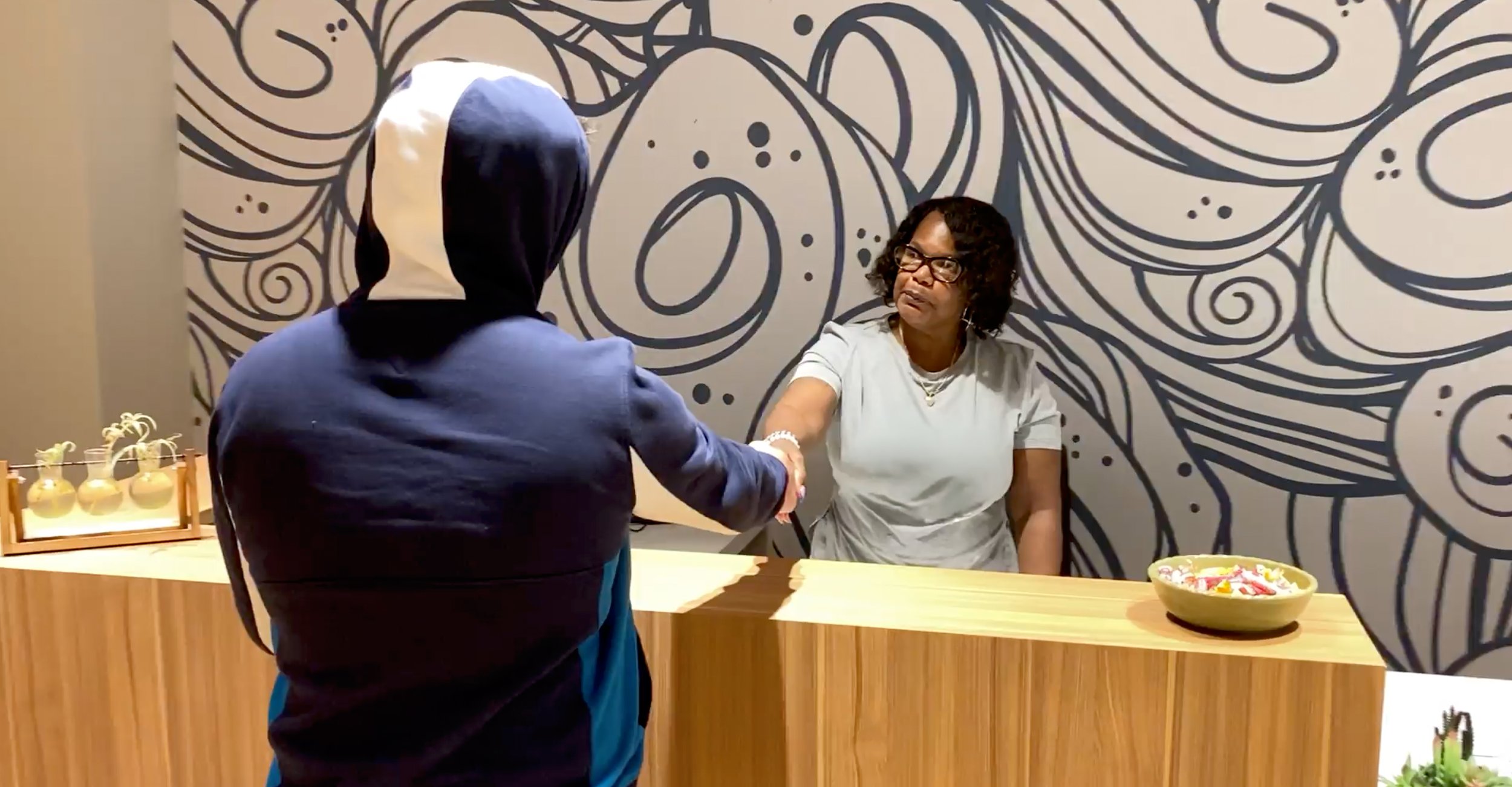
A Resident Service Coordinator welcomes a potential new resident to Weingart Tower
Weingart operates multiple Interim Housing and Permanent Supportive Housing locations throughout the greater Los Angeles area. But what sets Weingart apart is not the buildings; it’s what happens inside them. Every site pairs housing with on-site case management, mental health services, and substance use support. Residents aren't handed a lease and left to figure it out. A team of professionals works alongside them, helping them access benefits, manage health conditions, rebuild stability, and set goals.
For clients who've experienced domestic violence, Weingart screens and provides targeted support. That's because trauma doesn't end the moment someone walks through our door.
For people returning from incarceration, Weingart offers reentry services designed to reduce the chances of cycling back through the justice system.
For clients whose first language isn't English, language access and immigration support make sure that communication barriers don't become barriers to care.
For LGBTQ+ residents, who make up roughly 6–8% of LA’s homeless population and are nearly twice as likely as their non‑LGBTQ peers to have experienced homelessness in the past five years, Weingart provides affirming, judgment-free support that recognizes the specific barriers they face.
For adults carrying years of compounding hardship (lost jobs, untreated health conditions, strained relationships), Weingart takes the time to understand the full story. Because addressing the root causes of homelessness is how we help people move forward, not just find a place to sleep.
View our programs and services
The People Behind the Numbers
Statistics can feel heavy. But every number in this post represents a real person: someone with a history, a name, a set of things they love, and a desire for a life that feels like their own.
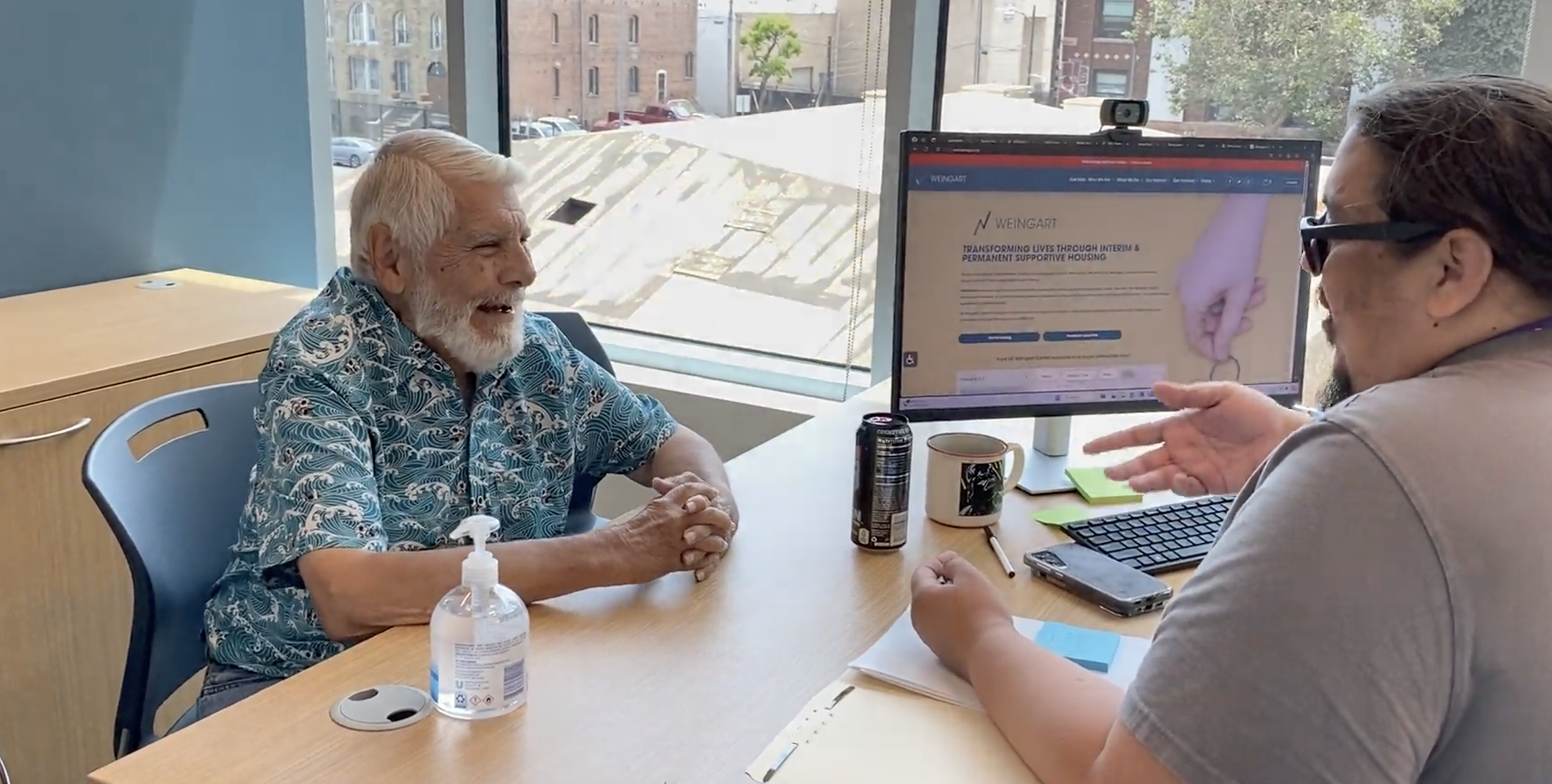
A Weingart Center resident meets with his Resident Service Coordinator to discuss benefits navigation
Weingart Center serves people across the spectrum. Our model doesn't sort people by who deserves help most. It starts from the belief that everyone who walks through the door deserves to be housed. Housing, paired with real, sustained support, is what actually works.
An Invitation to Be Part of the Solution
Los Angeles is at a turning point. Two consecutive years of decline in the homeless count signal that the investments being made in housing, in services, and in partnerships are starting to move the needle. That progress can slip, and it depends on the entire community: government agencies, nonprofits, businesses, and people like you.
Supporting Weingart Center means investing in a model that doesn't give up on people. It means funding the case manager who checks in every week, the mental health counselor who remembers someone’s name, the benefits navigator who helps someone access income for the very first time — the people who make ‘supportive’ in supportive housing real.
If you believe that everyone deserves a home — and the support to stay in it — Weingart Center is where that belief becomes action. Learn more about our work, share our story, or make a contribution. Because the measure of a city isn't just how many people are housed. It's how we treat the ones who aren't.